

The Math Ain't Mathing
Becoming Episcopalian one theological headache at a time


Tonight, in confirmation class at St. Luke’s Episcopal Church, we talked about the Holy Trinity and the early church, and I left with more thoughts than answers. Not because the Trinity itself is unfamiliar to me. It is not. Father, Son, and Holy Spirit have always been part of the language of my faith. I grew up with that. But tonight I found myself really stopping to think about it instead of just nodding along like a good church kid, and suddenly the math was not mathing.
I mean, is God a Gemini?
I ask that jokingly, but only sort of. You read the Old Testament, then the New Testament, and sometimes it can feel like spiritual whiplash. Add in the Trinity and suddenly you are trying to explain how God is one and also three and somehow not just three different costumes in a divine quick-change act. At a certain point, I start feeling like I need a whiteboard, a diagram, and maybe a nap.
I do not actually struggle with believing in God (most days). What I struggle with is explaining God in ways that do not sound absurd the moment they leave my mouth. The older I get, the more I realize faith is not always about solving the puzzle. Sometimes it is about standing in front of mystery long enough to admit that your categories are too small.
And apparently, I am not the first person to feel that way.
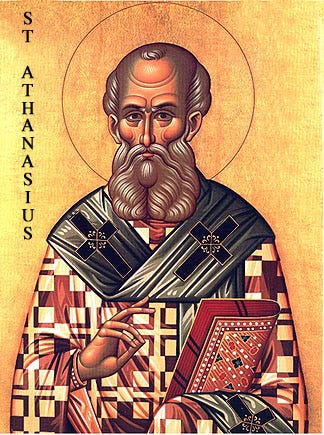
Tonight we talked about St. Athanasius and his work against Arianism, and I realized Christians have been arguing over this very stuff for a very long time. It turns out my little twenty-first century “hold on now” moment is actually one of the oldest arguments in church history. Athanasius fought against the idea that Jesus was not fully God in the same way as the Father, but instead a created being. The church did not treat that like some minor theological misunderstanding. They fought over it because it mattered. They believed it mattered deeply whether Jesus was truly divine or simply the holiest man to ever live.
Which, if I am being honest, is exactly the kind of thing that makes my brain short-circuit.
Because if I try to put myself back there, into that early world, I cannot pretend I would have been one of the cool, immediately faithful people with perfect instincts. Imagine being a monotheistic Jew with strict rules, deep tradition, and a very clear understanding of who God is and is not. Then this man shows up saying he is the Son of God, that “no one comes to the Father except through me,” and asking people to reorder their whole lives around him.
I am just being truthful here. If I had been standing on that street corner hearing all this for the first time, I do not know that my first thought would have been: “oh yes, this is surely the Messiah.”
I might have thought, well, there is a new local crackhead out on the street again. Or at the very least, this feels like the beginning of a cult documentary. Insert the Kool-Aid wine.
Was Jesus a cult leader?
A damn effective one, if so.
And yet, of course, I do not really mean that in the cheap or flippant sense. What I mean is that I am trying to take seriously how strange Jesus must have seemed to the people around him. We have had centuries to soften him with stained glass, Sunday school, framed verses, and tasteful church art. We have made him familiar. Respectable, even. But in his own time, Jesus was not respectable. He was disruptive, confusing, polarizing, and impossible to ignore. He made enormous claims. He gathered followers. He unsettled religious leaders. He challenged power. He performed miracles. He spoke with authority that either had to be received as divine or rejected as madness, blasphemy, or danger.
That is not a comfortable figure. That is a scandalous one.
And so this class has me thinking not only about Jesus, but about the Holy Spirit too, because that part of the Trinity feels even less settled in me.
Ross Kane said tonight that the Holy Spirit raised Jesus from the dead and returned him to the Father, and I sat there realizing that was not how I had ever really understood the resurrection story. My whole life, I was just told that Jesus rose from the dead after the crucifixion. Full stop. No one ever really paused to explain the Holy Spirit’s role in it, at least not in a way that stuck with me.
In my childhood church life, the Holy Spirit was mostly something people said was moving about in the church. The Spirit was in the room when people got swept up, spoke in tongues, cried, shouted, or swayed. The Holy Spirit felt less like a person of the Trinity and more like a kind of holy intensity. Or, as the kids say these days: “a vibe.” Something emotional. Something dramatic. Something people around me seemed to understand better than I did.
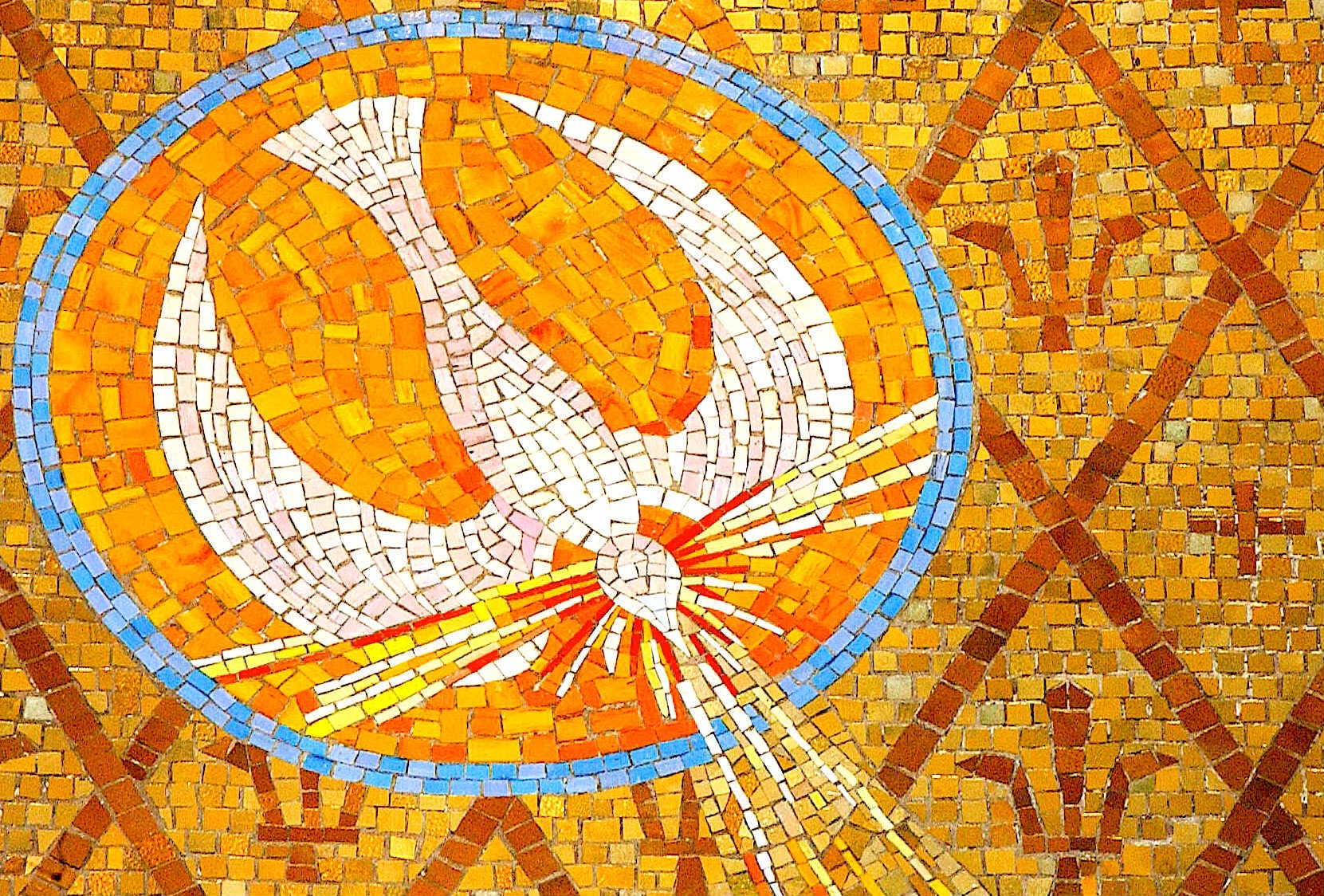
But tonight, hearing that the Holy Spirit raised Jesus from the dead and returned him to the Father, the Spirit suddenly felt much bigger to me than the vague church ghost of my childhood memory. Not just atmosphere. Not just emotional heat. Not just what made worship services feel intense. But resurrection. Power. Agency. Divine action. Life moving through death.
That startled me.
Maybe that is part of what becoming Episcopalian has been doing to me all along. It is not replacing the faith I grew up with so much as stretching it. Deepening it. Taking all the words I thought I knew and making them stranger, fuller, heavier.
Father. Son. Holy Spirit.
These are not just labels in a formula. They are not boxes to check so you can pass confirmation class. (Though I’m told, but not promised, that there is no test at the end.) They are relationship, communion, mystery, movement. They are the living God, and I am only just beginning to realize how little I have understood.
And the more I sit with all of that, the more convinced I become that if Jesus came today instead of all those years ago, we would kill him too.
I know I am not alone in that thought.
Human beings have never had a particularly good track record with truth-tellers, prophets, or people who show up and demand that the world become more just than it wants to be. Martin Luther King Jr. was shot down over the civil rights movement. Abraham Lincoln was assassinated in the long struggle over slavery and abolition. Those men were not Jesus, of course, and I do not mean to flatten them into some simple comparison. I mean that history shows again and again that people who threaten comfort, power, and hierarchy are often treated as dangerous. We tend to like moral courage much better once it is safely dead, quoted, memorialized, and no longer capable of interrupting us.
I do not think the world has gotten better at receiving what is holy. I think we have just gotten more sophisticated at rejecting it.
If Jesus came now, I think we would call him unstable, dangerous, extremist, blasphemous, politically inconvenient, socially disruptive, and a threat to public order. We would drag him on television, tear him apart online, and sort him into camps until no one could hear him anymore. Crucifixion did not end at Calvary. We have just found cleaner language for it.
That may sound cynical, but I do not mean it that way. I mean it as a confession. Because I do not get to stand outside the crowd and pretend I would have been better. I would like to think I would have recognized him. I would like to think I would have followed. I would like to think I would have known the difference between holy disruption and dangerous delusion. But I am not sure. And maybe part of faith is having the humility to admit that.
So no, I did not leave confirmation class with a clean answer about the Trinity or the early church. I left with a headache, a desire for an adult beverage, and the uneasy realization that Christians have been wrestling with this exact mystery for centuries. I left realizing that the Holy Spirit is bigger than I knew, that Athanasius fought over things I am only just beginning to understand, and that Jesus has always been harder to swallow than we make him out to be.
Maybe the math is not supposed to math.
Maybe faith is what happens when you stop trying to force God into your neat little categories and instead let yourself be undone by the possibility that God is bigger, stranger, and more alive than you imagined.
And maybe that is the point. But then again, maybe it’s not the point and I’m the crazy lady with a Substack. I’m sure someone will let me know eventually.
When I was in Egypt, standing in absolute awe in front of the pyramids, I heard someone behind me say, "Imagine, Moses walked by these pyramids every day."
Then it hit me. No wonder they hated Moses. I mean, sure, he was a Jew and all, so there was that. But, the Egyptians built pyramids to many different Gods, and here comes this guy who may have been a Jew, but he was brought up a proper Egyptian pantheist, and now he's talking about ONE God!!??!! I mean, look at all the work - not to mention mud and straw and slave labor - they could have saved if they didn't have so many gods.
I don't know why I had never thought of that before, but the thing about being an Episcopalian, as you're discovering, is that this is what it means to become an Episcopalian. You're always becoming. It really never ends. You never really "arrive," because you're still always getting there. And where you are is where you are. And, it's where you're supposed to be. For now.
I'm so glad you're here. I can't wait to see what more the Holy Spirit has in store for you.
I love how the Holy Spirit connects things, people, ideas. A dear friend of mine called me yesterday and we were talking about "progressive Christians." While he can't label himself as such, he said, "But I sure as hell love you guys." We talked about how this way of seeing "stretches" our understanding of G*d (as limited as they are) and makes it deeper, "stranger, fuller, heavier." Yes! "Seventy times seven," yes! Thank you for the confirmation on this Good word.